I am planning to build a house. I will record my considerations and requirements in this blog post.
Old-style tiled houses
This is a photo of my ancestral house where I was born. For hundreds or maybe thousands of years, people in Kerala built houses with sloping roofs. Unfortunately, it is rare these days to see a house being built with a sloping roof with old-style tiles. Tiled houses are associated with poverty. Terrace houses are the norm. It is not just a prestige issue. People think terraced houses are cooler and better. They could not be more wrong.
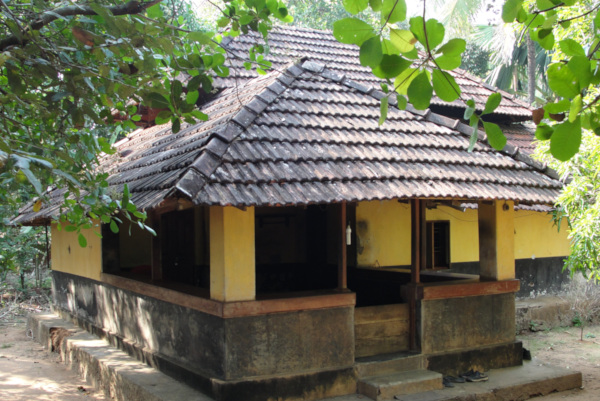
Some house owners do see the need for sloping roofs but choose more modern tiles or create concrete roofs that only look like tiles. Others, after a belated realization how hot their house gets in summer and how much dampness is felt in winter, put up a metal roof over the open terrace. This tin roof is an ugly contraption that makes a huge noise when rain hits them. In comparison, baked clay roof tiles do make some noise when rain drops hit them but not so much.
Another feature that old Kerala houses had was the thattil. It was in the middle of the house and was used as an attic. In my ancestral house, the thattil was used to dry parboiled paddy after it was boiled on a large earthen stove on the ground. All bedrooms were conveniently located below the thattil. These bedrooms were much cooler than surrounding rooms. The outer rooms would absorb heat during summer days and radiate it out during the night. The bedrooms below the thattil did not have such problems. They were protected from the Sun by the thattil and remained cool during the night.
Another intelligent feature of tiled roof was that it extended far out from the outer walls. (Not visible in the above photo is the roof in the back of the house which extended much further than in the front. This was because it was in the direction of the wind during rainy season.) The extra protrusion protected the walls from rain and sun's rays. An open terrace, in contrast, would heat up the walls by conduction. This made these cool house unbearably hot during summer. The open terrace also accummulates water during winter. Even if there are water evacuation holes and pipes, there is always water on the roof because of dirt and leaves that cause blockage. In the monsoon season, there is water on the roof all the time and the moisture invariably seepes through the roof and starts dripping below and also makes the walls damp. This water not only gets into the electrical system and causes faults, it also weakens the terrace. The reinforcement steels bars that holds the roof become corroded. It weakens and the terrace starts to sag. If you have overhead water tanks, the sagging is accelerated and the concrete breaks of the ceiling and falls down. In old tiled houses, these problems do not exist as the water easily rolls off the sloppy roof.
All around the house there was a raised platform that protect the house foundation from the water runoff. Even though the house was several feet down from the street, there was never any flooding. There was a coconut grove next to the house that was a few feet lower than than the house. Our plot was on the edge of a large rice field. That farm land was even lower by several feet.
Aspirational features of a modern house with old-style benefits
-
Foundation:
- Rock base: During winter months, the ground is always damp and there is a lot of water pressure. To prevent water absorption to the walls from the foundation, ordinary bricks will not be used.
- HDPE waterproofing layer: If cost-effective, adhesive HDPE
- Terrace
- Sloping roof: There will be a sloping roof on top of the house and for five feet all around it.
- Rainwater outlets: Whatever water accumulates on the terrace (not the roof) will be swiftly evacuated through evacuation outlet pipes.
- Large outlets: The openings of the pipes will be large enough so as not to be blocked by leaves, dried caked moss and other detritus that accumulates on the terrace.
- No barriers to evaporation: The terrace will not be waterproofed or covered with tiles. If there is such a water barrier, water will seep through even the tiniest holes and accumulate underneath. This moisture will not be able to evaporate through exposure to sun rays or dry air. It will have have no way but down thanks to gravity and capillary pressure.
- No water tanks: Large water tanks will be avoided on the roof.
- They create an imbalance in the weight distribution on the foundation.
- Their overflow
- cannot be observed from the ground floor
- causes the terrace to be wet
- Staircase: There will be a covered external staircase.
- Gate: There will be an iron gate in the middle of the stairs to prevent unauthorized entry by humans and dogs.
- No internal staircase:
- a waste of valuable space
- usually not supported by the foundation.
… to be continued.
A Vastu-compliant house plan in a East-facing plot
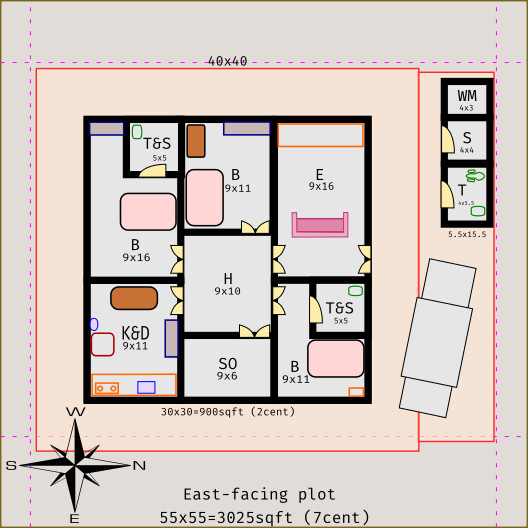
Recently, I updated my book Vastu Shastra Explained with this image and three other images (for the other cardinal directions). This plan for a 900sqft house has three bedrooms, a kitchen-cum-dining room, one home theater, a central hall and a sitout.